
Affiliate disclosure: As an Amazon Associate we earn from qualifying purchases. If you buy through our links, we may earn a commission at no extra cost to you.
The Question Behind the Question
Open any Christmas cookie recipe and read the instructions: “cream butter and sugar until light and fluffy, 5 to 7 minutes.” The recipe assumes a stand mixer is doing the work. But a good stand mixer costs several hundred dollars, and the $30–$60 hand mixer sitting in your drawer promises to do the same job.
So the real question isn’t which mixer is “better.” It’s this: can the cheap handheld tool actually get the job done, or is the big machine worth the money?
Here’s the one-sentence answer: a hand mixer is perfectly fine for cakes, frosting, and whipped cream — but it cannot replace a stand mixer for dough, big batches, or hands-free work. And most serious holiday bakers end up owning both.
This guide defines each tool honestly, compares them head-to-head across the dimensions that actually matter, and ends with a clear buy recommendation — timed for Christmas baking season, when this decision gets made.
The Short Answer
- Buy a stand mixer if you bake weekly, make bread dough, or batch-bake for holidays — it’s the bottleneck behind almost every Christmas recipe.
- Buy a hand mixer if you bake occasionally, mostly cakes and frosting, and want something cheap, light, and easy to store.
- Bake more than twice a month? The stand mixer pays for itself in one holiday season — in time saved alone.
What Is a Stand Mixer?
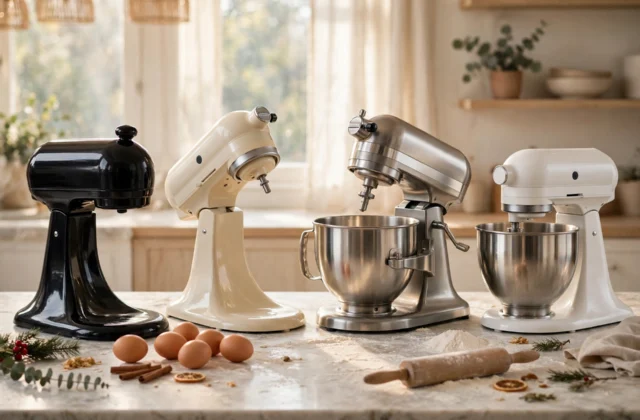
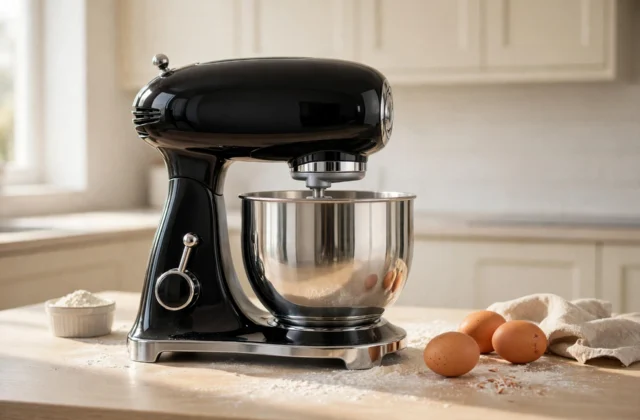
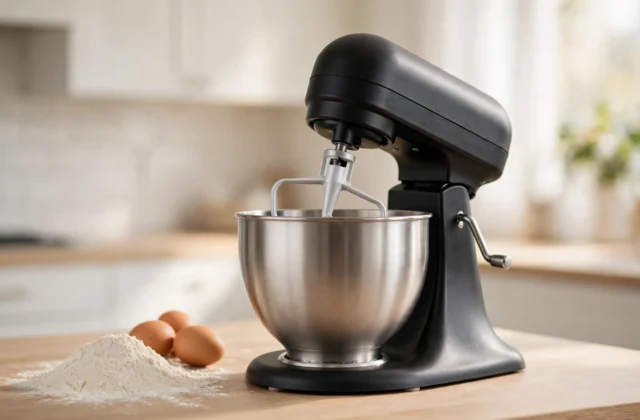
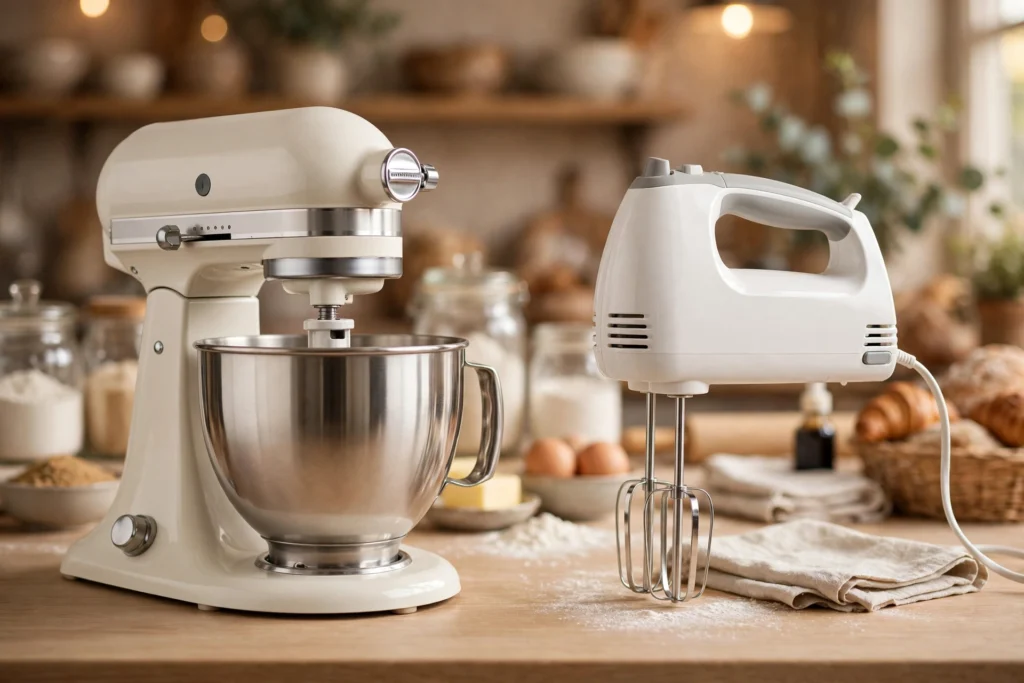
A stand mixer is a countertop machine: a heavy base with a fixed mixing bowl and an overhead arm that drives interchangeable attachments — flat beaters, wire whisks, and dough hooks. The signature mechanism is planetary mixing: the beater spins on its own axis while orbiting the bowl, so it reaches every bit of the mixture without you touching it.
What it does best: creaming butter and sugar for cookie dough, kneading bread dough, whipping large volumes of cream or egg whites, and handling double or triple batches without breaking a sweat. It works hands-free — you pour ingredients in and walk away.
The honest caveats: it’s a countertop commitment. Quality stand mixers weigh 15–30 pounds (bowl-lift models most of all), occupy real counter space, and sit in the $200–$600 range for the good ones. For a single batch of brownies once a month, it’s overkill.
The real moat isn’t the motor — it’s the attachment ecosystem. A KitchenAid-style hub accepts 10+ attachments (pasta makers, grain mills, meat grinders), which turns one machine into a small kitchen factory. No hand mixer offers anything like it.
If you’re already leaning this way, see our full ranking of the best stand mixers for 2026, where we compare seven models across every budget.
What Is a Hand Mixer?
A hand mixer is a handheld motor unit — usually 2 to 3 pounds — with two removable beaters (some models include dough hooks and a whisk) that you guide around the bowl yourself. Most run 5 to 9 speeds at roughly 200–300 watts.
What it does best: cake batters, whipped cream, frostings, meringue, and small-batch cookies — anything light that mixes in under five minutes. For quick jobs, it’s genuinely faster than hauling out a stand mixer: grab it from the drawer, plug in, done.
The honest caveats: you are the stand. An 8-minute creaming session is an arm workout, and you can’t prep the next step while it runs. Stiff dough is the killer — thick bread or bagel dough overheats the small motor, which is the number one way hand mixers die. Anything beyond a standard single batch gets unwieldy: splatter, uneven mixing, fatigue.
The price framing says it all: quality hand mixers run $30–$80 — roughly the price of one stand-mixer attachment. It’s a disposable-cost tool, which is both its appeal and its limit.
Head-to-Head Comparison
Mixing Power and Dough Capability
This is the dividing line, so let’s start here.
A stand mixer’s torque plus planetary action handles stiff bread dough, bagel dough, and triple-batch cookie dough without bogging down. The motor doesn’t care that the dough fights back — that’s what it was built for.
A hand mixer is adequate for batters and creaming, but stiff dough strains the small motor. You’ll hear it: the pitch drops, the beaters slow, and with repeated abuse the motor overheats and dies early. There’s an honest rule of thumb — if the dough fights back, the hand mixer loses.
Verdict: dough is the dividing line. Everything else is negotiable.
If bread is your priority, see our full Bosch Universal Plus review.
Hands-Free vs Hands-On
A stand mixer’s superpower isn’t power — it’s time. Set it running and walk away: add ingredients mid-mix, line the next baking sheet, handle the holiday chaos. Ask stand-mixer owners what they love most and “I can do other things while it mixes” comes up more than any spec.
A hand mixer demands your full attention for the entire mix. You hold it, you guide it, you feel every minute of that 8-minute creaming in your wrist. Quick jobs are fine; long ones are a commitment.
Verdict: the stand mixer buys you time; the hand mixer only saves you money.
Batch Size
A 5–7 quart stand-mixer bowl handles 9+ dozen cookies or multiple loaves per batch — it’s built for cookie exchanges, bake sales, and Christmas crowds. Scale up a recipe and the machine doesn’t notice. And that big batch of spritz dough has to go somewhere — our best cookie press guide covers the shaping end of the job.
A hand mixer works in whatever bowl you already own, but anything beyond a standard single batch gets unwieldy. Splatter increases, mixing goes uneven, your arm gives out before the batter is done. You can do two batches back-to-back, but you’ve just doubled your labor.
Verdict: holiday batch-baking is a stand-mixer job.
Attachments and Versatility
Stand mixers win this category by a mile, and it’s not close. The attachment-hub ecosystem — pasta rollers, grain mills, meat grinders, vegetable sheeters — means one machine keeps gaining jobs over the years. We cover the ecosystem in detail in our best stand mixer guide.
Hand mixers are one-trick tools. Some include dough hooks and a whisk, but there’s no ecosystem to grow into — what you buy on day one is all you’ll ever have.
Verdict: if “one machine, many jobs” appeals to you, there’s no contest.
Counter Space, Storage, and Weight
Here’s the one category the hand mixer wins outright — and it wins big.
A stand mixer either lives on your counter permanently (that’s the point — you use it more when it’s out) or needs a dedicated cabinet spot. At 15–30 pounds, “putting it away” is a chore, not a habit. Small kitchens feel this cost every day.
A hand mixer fits in a drawer, weighs 2–3 pounds, and travels to a friend’s kitchen for group baking sessions. Zero lifestyle friction.
Verdict: the only category the hand mixer wins outright — but for small kitchens, it matters.
Price and Value
Quality stand mixers sit in the $200–$600 range; quality hand mixers in the $30–$80 range. The stand mixer costs roughly 5–10x more upfront.
But run the value math over time: a stand mixer that lasts 10+ years costs less per bake than replacing a burned-out hand mixer every two holiday seasons. And a stand mixer that turns your Christmas baking from an all-weekend ordeal into an afternoon has a value no spec sheet captures.
One more timing note: stand mixers see their deepest discounts of the year in late November — more on that below.
Verdict: the hand mixer is cheaper; the stand mixer is the better value for anyone who bakes regularly.
Who Should Buy Which
Get the stand mixer if you check most of these:
- You bake 2+ times a month, year-round
- You make bread, pizza dough, or bagels — anything stiff
- You batch-bake for holidays, gifts, or cookie exchanges
- You want hands-free mixing so you can multitask
- The attachment ecosystem appeals to you — one machine, many jobs
- You have counter or cabinet space to give it a home
Convinced? Here are the 7 best stand mixers for 2026, compared in full detail — including which models handle bread dough best.
Get the hand mixer if you check most of these:
- You bake occasionally — a few times a year, not weekly
- Your baking is mostly cakes, cupcakes, frosting, and whipped cream
- You have a tiny kitchen and no room for a countertop machine
- You’re buying your very first mixer on a tight budget
- You want a quick-grab tool for small jobs alongside a stand mixer you already own
Ready to pick one? See our 7 best hand mixers for 2026.
Own both if: you’re the household’s designated holiday baker. This is the setup many serious bakers land on: the stand mixer as the workhorse for dough and batches, the hand mixer for quick frostings and small jobs where hauling out the big machine feels silly. And once the baking’s done, our cookie decorating kit guide picks up where the mixer leaves off.
The Black Friday Angle
If this comparison convinced you on the stand mixer, here’s the timing logic: stand mixers see their deepest discounts of the year in late November. We documented $150–200 cuts on flagship models during October’s Prime event — and October cuts on these machines have a strong habit of repeating (or deepening) on Black Friday.
So the smart move: pick your model now from our best stand mixer guide, then watch for our Black Friday deal posts in late November. Choosing the model before the sales start means you buy in minutes when the price drops, instead of researching under pressure.
No prices here — just the timing logic. The deal posts will have the numbers.
FAQs
Can a hand mixer knead bread dough?
Not really. It can start a soft dough, but stiff bread dough strains the small motor — audible slowdown, overheating, and a shortened lifespan. Hand-mixer dough hooks are a backup feature, not a kneading solution. For real bread baking, a stand mixer with a proper dough hook (see our best stand mixer picks) is the right tool.
Is a stand mixer worth it if I only bake at Christmas?
It depends on the scale of that Christmas. If your holiday involves cookie exchanges, gift tins, and multiple batches, one season justifies the machine. If it’s a single batch of sugar cookies a year, a hand mixer is the honest answer — save the money.
What’s the real difference between a $50 hand mixer and a $350 stand mixer?
It’s not just “more power” — it’s torque under load, hands-free operation, batch capacity, a 10+ year lifespan, and the attachment ecosystem. You’re buying a different category of tool, not a bigger version of the same one.
Can I use a hand mixer for cookie dough?
Yes for standard drop-cookie dough — a hand mixer handles a normal single batch fine. The trouble starts with triple batches or stiff doughs (shortbread, gingerbread): that’s when the motor tells you it’s unhappy. Listen to it.
Do I need both a stand mixer and a hand mixer?
Many serious bakers end up with both, and it’s not redundant: the stand mixer does dough, batches, and hands-free work; the hand mixer does quick frostings, whipped cream, and small jobs. If you bake weekly, the pair covers everything. If you bake monthly, the stand mixer alone suffices.
Which stand mixer should I buy?
Our full best stand mixer 2026 guide compares seven models — from budget picks to the KitchenAid workhorses — with a buying guide that matches each to a baking style.
Tilt-head or bowl-lift — does it matter for a first stand mixer?
Short version: tilt-head for most bakers (easier bowl access, adding ingredients, scraping down), bowl-lift for bread bakers and heavy batch bakers (more stable, more powerful, handles the stiffest doughs). Our stand mixer guide’s buying section breaks this down in full.
Final Recommendation
The dividing line is simple: dough + batches + frequency → stand mixer; occasional light baking → hand mixer. Everything else — counter space, budget, the attachment ecosystem — just weights the decision.
If you’re the household’s holiday baker, or you want to become one, the stand mixer is the single highest-leverage purchase in baking. It’s the tool every Christmas recipe assumes you own.
→ Compare the 7 best stand mixers for 2026 — picks, buying guide, and the Black Friday timing play, all in one place.
Affiliate disclosure: As an Amazon Associate we earn from qualifying purchases. If you buy through our links, we may earn a commission at no extra cost to you.