
Affiliate disclosure: As an Amazon Associate we earn from qualifying purchases. If you buy through our links, we may earn a commission at no extra cost to you.
The Mixer Most Bakers Actually Reach For
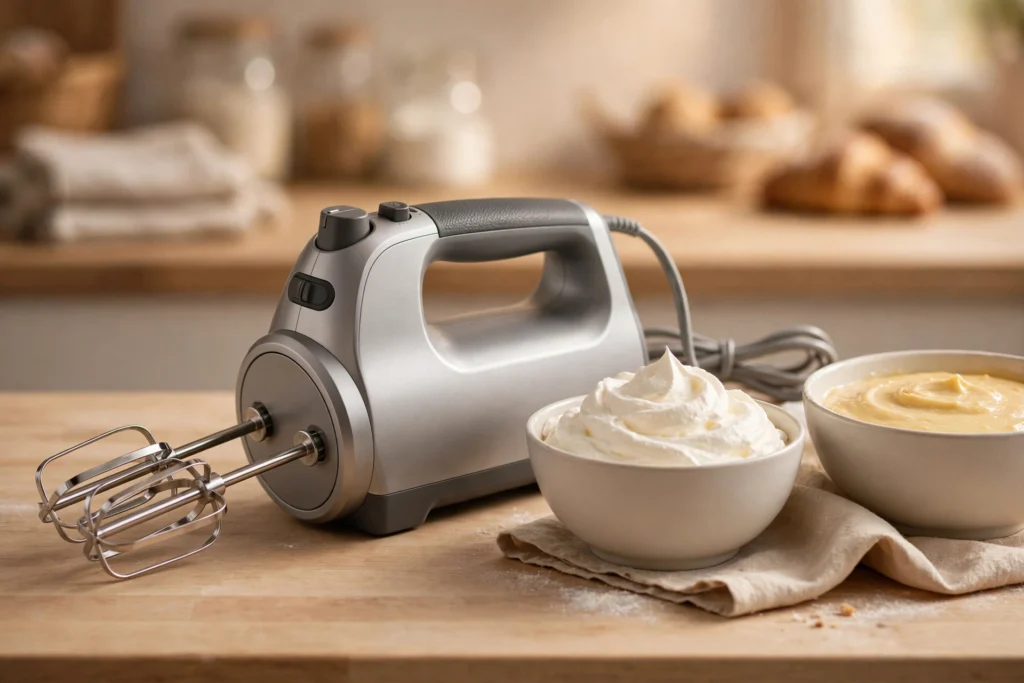
Here’s the honest truth about holiday baking: most home bakers don’t need a several-hundred-dollar stand mixer. A good hand mixer handles cakes, frosting, whipped cream, and standard cookie dough for a fraction of the price — and it lives in a drawer, not on your counter.
The right hand mixer is the one you’ll actually grab: light enough to hold comfortably for five minutes, strong enough not to strain on cookie dough, and equipped with the attachments that cover real jobs. That’s the whole test.
One boundary up front: if you bake bread or big holiday batches, a hand mixer is the wrong tool — read our best stand mixer guide instead. This guide is for everything else. And if you’re still deciding between the two categories, our stand mixer vs hand mixer comparison walks through the full decision.
Christmas is hand-mixer season, by the way. Frosting, whipped cream, meringue, cookie dough — the jobs that fill December kitchens are exactly the jobs a hand mixer does best.
Quick Picks
Best Overall — KitchenAid 9-Speed (KHM926): The workhorse. Nine speeds with a true low, soft-start, and the full attachment set. The default right answer for regular bakers.
Best Value — Cuisinart Power Advantage Plus 9-Speed (HM-90BCS): Nine speeds, precision control, and a category-leading owner consensus — at a lower tier than the KitchenAid. Amazon’s Choice, #7 in Hand Mixers.
Best Budget — Black+Decker 6-Speed (MX3200B): Genuinely 6 speeds, a snap-on storage case, and the cheapest way to a competent mixer. The honest starter pick.
Best Quiet/Premium — Breville Handy Mix Scraper (BHM800SIL): Scraper beaters that actually scrape the bowl, noticeably quieter operation, and premium build. The upgrade pick.
Best Cordless — KitchenAid Go Cordless (KHMR762): No cord, no outlet hunt — grab it and mix anywhere. Convenience has a price, and this is it.
Best for Small Kitchens — KitchenAid 6-Speed with Flex Edge (KHM6118): Flex-edge beaters that cut down on scraping, in a lighter, simpler package. The small-kitchen sweet spot.
Best Pro-Style — Hamilton Beach Professional 7-Speed Digital (62656): A digital display, slow-start, and a professional feel at a mid-range tier. The spec-sheet pick.
Best Hand Mixer Comparison
| Product | Best For | Design / Key Features | Key Spec |
|---|---|---|---|
| KitchenAid 9-Speed (KHM926) | Best overall | 9 speeds, soft-start, full attachment set | Beaters + whisk + dough hooks |
| Cuisinart Power Advantage Plus 9-Speed (HM-90BCS) | Best value | 9 speeds, precision control | Amazon’s Choice; #7 in Hand Mixers |
| Black+Decker 6-Speed (MX3200B) | Best budget | 6 speeds, snap-on storage case | Lightweight, drawer-friendly |
| Breville Handy Mix Scraper (BHM800SIL) | Quiet / premium | Scraper beaters, quieter motor | #25 in Hand Mixers |
| KitchenAid Go Cordless (KHMR762) | Cordless | Battery-powered, no outlet needed | 7 speeds; rechargeable battery |
| KitchenAid 6-Speed Flex Edge (KHM6118) | Small kitchens | Flex-edge beaters, lighter build | Beaters + whisk + dough hooks |
| Hamilton Beach Professional 7-Speed Digital (62656) | Pro-style | Digital display, slow-start | 7 speeds; snap-on case |
What Actually Matters in a Hand Mixer
Power, Honestly
Watts measure electricity draw, not mixing strength — but the number still tells you something. Under roughly 200W, you’ll feel it on cookie dough: the motor strains, the pitch drops, the beaters slow. Around 250W and up with good gearing is the comfort floor for real baking. (Same logic as our stand-mixer guide: gearing matters more than the wattage number, but wattage tells you the machine’s intent.) Every pick on this list clears the comfort floor for cakes, frosting, and standard cookie dough.
Weight and Grip
You’re holding this thing for 5–10 minutes straight, so weight is a daily-comfort spec, not a footnote. The 2–3 pound range is the comfort zone — light enough to hold without wrist fatigue, heavy enough to feel stable. Cordless models trade weight for convenience: the battery adds heft, and you’ll feel it on longer jobs. Grip matters too: a handle that fits your hand and a trigger you can hold without cramping beats a prettier design every time.
Attachments That Matter
Beaters are table stakes — every mixer has them, and they do 90% of the work. A whisk is the second attachment worth having: whipped cream and egg whites go dramatically faster with one. Dough hooks are the honest-limit attachment — they handle light, soft doughs briefly, and that’s it. They do not turn a hand mixer into a bread machine. Flex-edge / scraper beaters are the one real innovation in the category: a silicone edge that scrapes the bowl as it spins, cutting down on stop-and-scrape time. If you make a lot of frosting, they’re worth seeking out.
Speeds and Control
Five speeds is the practical minimum; more is nice but not decisive. What matters is the spread: a true low that doesn’t fling flour across the kitchen, a mid-range for creaming, and a turbo for finishing. Avoid models where “low” still flings batter — owners report that as a dealbreaker more than any missing feature. A soft-start or slow-start function (the motor ramps up instead of jumping to full speed) is the single best cure for the flour-cloud problem.
Storage
The number-one owner complaint about hand mixers isn’t power — it’s storage. Loose beaters in a drawer, a cord that tangles, a mixer that slides around. Models with a snap-on storage case or a heel rest win real-world points far out of proportion to their price. If your kitchen is short on drawer space, treat the storage case as a deciding feature, not a bonus.
The Honest Limit
Stiff bread dough and triple-batch cookie dough kill hand mixers. The small motor overheats, the gears strain, and that’s the number-one way these machines die young. It’s not a defect — it’s physics. If your baking regularly includes bread, pizza dough, or big holiday batches, that’s the best stand mixer guide’s job, not this one’s. If you bake bread regularly, our Bosch Universal Plus review is the stand-mixer option to look at.
1. KitchenAid 9-Speed (KHM926) — Best Overall
If you buy one hand mixer in 2026, make it this one. The KitchenAid 9-Speed is the category’s workhorse: nine speeds with a genuinely usable low, soft-start that keeps flour in the bowl, and the full attachment set — beaters, whisk, and dough hooks — in the box. Owners report it as the mixer that just does everything without drama: cakes, frosting, whipped cream, standard cookie dough, meringue.
The soft-start is the feature you’ll notice first. Instead of jumping to full speed and blasting flour across the counter, the motor ramps up — a small thing that makes every bake less messy. The nine-speed spread gives real control at both ends: a true low for folding in flour, a turbo for finishing whipped cream. And the build feels like a KitchenAid: solid, balanced, and comfortable to hold through a full creaming session.
Specs: 9 speeds · soft-start · beaters + whisk + dough hooks included · multiple color variants.
Pros: The most complete hand mixer in the category; soft-start genuinely reduces mess; comfortable grip for long sessions; strong owner consensus across years of kitchens.
Cons: Premium-tier pricing for a hand mixer; the 1-year warranty is short for the price; heavier than the budget picks (the price of solid build).
Who it’s for: The default recommendation — regular home bakers who want one hand mixer that covers everything, bought once.
2. Cuisinart Power Advantage Plus 9-Speed (HM-90BCS) — Best Value
The Cuisinart HM-90 is the rational pick: nine speeds, precision control, and the strongest owner consensus in the value tier — Amazon’s Choice, #7 in Hand Mixers, with 11,000+ ratings behind it. Owners consistently describe it as the mixer that punches above its tier: smooth speed control, a comfortable grip, and enough power for everything short of bread dough.
The precision control is the differentiator here. Where cheaper mixers jump from “barely moving” to “flour everywhere,” the HM-90’s speed dial gives you fine gradations — and the low end is genuinely low. That matters most for the two jobs that punish sloppy speed control: folding flour into cake batter and starting a frosting without a sugar cloud.
Specs: 9 speeds · precision speed dial · beaters + whisk + dough hooks included · snap-on storage case.
Pros: Category-leading value; precise speed control with a true low; strong owner consensus (11,000+ ratings); storage case included.
Cons: Feels less premium than the KitchenAid in hand; the attachment set is functional rather than generous; not the quietest in the category.
Who it’s for: Bakers who want 90% of the KitchenAid’s capability at a meaningfully lower tier — the smart-money pick.
3. Black+Decker 6-Speed (MX3200B) — Best Budget
The honest starter pick. The MX3200B gives you six real speeds, a snap-on storage case, and a competent motor — at the cheapest tier on this list. For someone buying their first mixer, baking a few times a year, or replacing a dead hand-me-down, this is the mixer that makes sense.
Let’s be clear about what you give up at this tier: the build is lighter and plasticky, the motor has less headroom on thick cookie dough, and the low speed isn’t as gentle as the premium picks. But owners report it handles cakes, frosting, whipped cream, and standard batches without complaint — which is exactly what a budget mixer needs to do. The storage case is the surprise win: beaters and cord clip on, and the whole thing goes in a drawer cleanly.
Specs: 6 speeds · beaters included · snap-on storage case · lightweight build.
Pros: The cheapest competent mixer on this list; storage case solves the #1 owner complaint; light and easy to hold; genuinely 6 speeds (not a mislabeled legacy model).
Cons: Plastic gears and lighter build mean a shorter expected life under heavy use; less headroom on thick dough; the low speed flings more than the premium picks.
Who it’s for: First-mixer buyers, occasional bakers, and anyone who wants a capable mixer at the lowest sensible tier.
4. Breville Handy Mix Scraper (BHM800SIL) — Best Quiet / Premium
The upgrade pick. The Breville Handy Mix Scraper earns its premium tier with two things no other mixer here has: scraper beaters and noticeably quieter operation. The beaters carry a silicone edge that scrapes the bowl as they spin — owners report meaningfully less stop-and-scrape time, especially on frosting and thick batters. And the motor runs quieter than anything else in this category, which matters more than you’d think during a long creaming session.
The rest of the package matches the premium billing: a thoughtful grip, a clean design, and a beater-eject system that doesn’t fight you. This is the mixer for someone who bakes often enough that the small daily frictions — noise, scraping, cleanup — add up to a real quality-of-life difference.
Specs: Scraper beaters (silicone edge) · quieter motor · #25 in Hand Mixers · premium build.
Pros: Scraper beaters genuinely cut scraping time; the quietest mixer on this list; premium feel and thoughtful design; strong for frosting-heavy bakers.
Cons: Premium-tier pricing; the scraper beaters are the star — without them it’s a very good but ordinary mixer; heavier than the budget picks.
Who it’s for: Frequent bakers, frosting-heavy bakers, and anyone who’ll pay more to make the daily job quieter and cleaner.
5. KitchenAid Go Cordless (KHMR762) — Best Cordless
The convenience pick. The KitchenAid Go Cordless cuts the cord entirely: no outlet hunt, no cord draped across the counter, no cord wrapping around the bowl. Grab it from the drawer, mix wherever you’re standing, put it back. For quick jobs — a single batch of frosting, whipped cream for dessert, a small cake batter — owners report it’s genuinely faster than a corded mixer, because setup drops to zero.
The trade-offs are the ones every cordless tool has. The battery adds weight, so long sessions feel it more. Battery anxiety is real: the mixer is only as ready as its last charge, and heavy use drains it faster than light jobs. And you pay a premium for the convenience — cordless costs more than an equivalent corded mixer. But if your kitchen has one awkward outlet, or you bake at other people’s kitchens, the freedom is worth it.
Specs: Battery-powered (rechargeable) · 7 speeds · cordless design · KitchenAid build quality.
Pros: Total freedom of movement; zero setup for quick jobs; the most convenient mixer on this list; same KitchenAid build feel.
Cons: Battery adds weight and needs charging; premium-tier pricing for cordless convenience; sustained heavy use drains the battery fastest.
Who it’s for: Quick-job bakers, small kitchens with awkward outlets, and anyone who values grab-and-go over raw power per dollar.
6. KitchenAid 6-Speed with Flex Edge (KHM6118) — Best for Small Kitchens
The small-kitchen sweet spot. The KHM6118 pairs six speeds with KitchenAid’s Flex Edge beaters — the silicone-edged design that scrapes the bowl as it spins — in a lighter, simpler package than the 9-speed flagship. Owners report it as the mixer that does the one thing most hand mixers don’t: it keeps the bowl scraped without stopping, which makes frosting and thick batters noticeably less fussy.
The “small kitchens” verdict isn’t just about size. It’s about the whole package being right-sized: fewer speeds to fuss with, a lighter body that’s easy to lift in and out of a drawer, and the Flex Edge beaters doing the work that usually requires stopping and scraping. If your kitchen is tight and your baking is cakes, frosting, and cookies — not bread — this is the mixer that fits.
Specs: 6 speeds · Flex Edge beaters (silicone edge) · beaters + whisk + dough hooks included · lighter build.
Pros: Flex Edge beaters cut scraping time; lighter and simpler than the 9-speed; KitchenAid build quality; well-suited to small kitchens and drawers.
Cons: Six speeds instead of nine (fewer gradations); no soft-start; premium-brand pricing for a mid-tier feature set.
Who it’s for: Small-kitchen bakers, frosting lovers, and anyone who wants the Flex Edge advantage without the flagship’s size and price.
7. Hamilton Beach Professional 7-Speed Digital (62656) — Best Pro-Style
The spec-sheet pick. The Hamilton Beach Professional 62656 brings a digital display, slow-start, and a professional feel to the mid-range tier. The digital readout is more than a gimmick: owners report it makes speed selection precise and repeatable — you know exactly which speed you’re on, and you can return to it next time. Slow-start keeps flour in the bowl the way soft-start does on the premium picks.
This is the mixer for the baker who likes numbers and control. Seven speeds with a digital display, a snap-on case, and a build that feels more substantial than the budget tier. It won’t out-mix the KitchenAid 9-speed on pure capability, but it offers the most controlled, most deliberate mixing experience at its tier — and for some bakers, that’s the deciding factor.
Specs: 7 speeds · digital display · slow-start · snap-on storage case.
Pros: Digital display makes speed selection precise and repeatable; slow-start reduces mess; professional feel at a mid-range tier; storage case included.
Cons: The digital display adds complexity some bakers won’t want; less owner consensus than the KitchenAid/Cuisinart picks; mid-range build, not premium.
Who it’s for: Control-oriented bakers, gadget lovers, and anyone who wants the most deliberate mixing experience at a mid-range tier.
Hand Mixer vs Stand Mixer — the 60-Second Recap
If you landed here directly and you’re still wondering whether a hand mixer is even the right category: the dividing line is simple. Dough + batches + frequency → stand mixer. Everything else → you’re in the right place.
A stand mixer wins on stiff dough, triple batches, and hands-free work — it runs while you do something else. A hand mixer wins on price, weight, storage, and quick jobs — it’s the tool you grab for a single batch of frosting or whipped cream. Most serious holiday bakers end up owning both: the stand mixer as the workhorse, the hand mixer for the quick jobs where hauling out the big machine feels silly.
Still undecided? Our full stand mixer vs hand mixer comparison breaks down all six head-to-head dimensions. Convinced you need the bigger machine? Our best stand mixer guide compares seven models across every budget.
FAQs
Can a hand mixer handle cookie dough?
Yes — standard single batches of drop-cookie dough are well within a hand mixer’s comfort zone. The trouble starts with triple batches or stiff doughs (shortbread, gingerbread): that’s when the motor strains and the beaters slow. For big holiday batches, a stand mixer is the honest answer.
Can a hand mixer knead bread dough?
Light, soft doughs — briefly, as a backup. Regular bread baking needs a stand mixer with a proper dough hook: stiff dough is the number-one way hand mixers die. See our best stand mixer guide if bread is a regular part of your baking.
How many watts should a hand mixer have?
Around 250W and up with good gearing is the comfort floor for real baking. Below roughly 200W, you’ll feel the motor strain on cookie dough. But wattage isn’t the whole story — gearing matters more than the number, which is why a well-built 250W mixer out-mixes a cheap 300W one.
Are dough hooks on hand mixers worth it?
For soft doughs, yes — they’re a useful backup for a quick pizza dough or a soft roll recipe. But they don’t turn a hand mixer into a stand mixer. Treat them as a “sometimes” feature, not a bread-baking solution.
Corded or cordless?
Corded wins on power per dollar and never needs charging — the right call for most bakers. Cordless wins on convenience: zero setup, mix anywhere, no outlet hunt. The trade-off is weight (the battery adds heft), battery anxiety, and a premium price. If you bake quick jobs often, cordless earns its keep; otherwise, corded is the smarter buy.
How long should a hand mixer last?
Five to ten years for a quality mixer used within its limits. The killer is sustained stiff-dough work — repeated bread dough overheats the small motor and shortens its life dramatically. Used for cakes, frosting, and standard batches, a good hand mixer is a long-lived tool.
Should I buy a hand mixer now or save up for a stand mixer?
It depends on what you bake. If your baking is mostly cakes, frosting, whipped cream, and standard cookie batches, buy the hand mixer now — a stand mixer would be overkill for those jobs, and you’d wait months for no reason. If you bake bread, batch-bake for holidays, or bake weekly, save for the stand mixer instead. Our stand mixer vs hand mixer comparison walks through the full decision if you’re still torn.
Final Recommendation
The honest summary: a hand mixer is the right tool for most home bakers, most of the time. For cakes, frosting, whipped cream, and everyday baking, it’s cheaper, lighter, faster to set up, and easier to store than any stand mixer.
Buy the KitchenAid 9-Speed (KHM926) if you want the best hand mixer, full stop — the most complete package in the category. Buy the Cuisinart HM-90 if you want the smart-money pick — 90% of the capability at a lower tier. Buy the Black+Decker MX3200B if you’re starting out or baking occasionally — the cheapest competent mixer that won’t frustrate you. Buy the Breville if frosting is your life and you want the quietest, cleanest experience. Buy the KitchenAid Go Cordless if convenience beats everything else.
Still undecided between categories? Our stand mixer vs hand mixer comparison has the full breakdown. Need dough power instead? Our best stand mixer guide is where that decision lives. And once the mixing’s done, our cookie decorating kit guide picks up where the mixer leaves off — frosting is only half the job.
— start with the KitchenAid 9-Speed, the default right answer.
Affiliate disclosure: As an Amazon Associate we earn from qualifying purchases. If you buy through our links, we may earn a commission at no extra cost to you.