
Affiliate disclosure: Baking Gear Lab is reader-supported. When you buy through links on this page, we may earn a commission at no extra cost to you.
Few appliances are as instantly recognizable in a home kitchen as the KitchenAid Artisan. With its tilt-head silhouette and rainbow of colors, the Artisan Series 5-Quart (KSM150PS) has been the default answer to “which stand mixer should I buy?” for well over a decade. But in 2026 — with credible rivals undercutting it on price and wattage — is the Artisan still worth it?
Our honest answer: for most home bakers, yes — with a couple of important caveats about heavy dough and full retail pricing. Here’s what this 5-quart workhorse does brilliantly, where it falls short, who should buy it, and when to wait for a sale.
Comparing several models? See our Best Stand Mixer 2026 roundup for the full field. And if you’re still deciding between mixer types, read Stand Mixer vs Hand Mixer: Which Should You Buy?
Quick Verdict
The KitchenAid Artisan is still the stand mixer we’d recommend to most home bakers in 2026. Its 5-quart bowl, 10 speeds, and 59-point planetary mixing handle roughly 90% of home baking — cookies, cakes, frostings, batters, whipped cream — with ease, and the attachment hub gives it a long useful life well beyond mixing. The caveats: it’s not the strongest choice for heavy bread dough (keep it on speed 2), the included beaters are coated rather than stainless steel, and at full price it’s a premium buy. Buy it on sale and it’s an easy recommendation.
KitchenAid Artisan: Key Specs
| Brand | KitchenAid |
|---|---|
| Model | KSM150PS |
| Capacity | 5 qt |
| Power | 325 W |
| Speeds | 10 |
| Design | Tilt-head |
| Mixing | 59-point planetary |
| Bowl | Stainless steel with handle |
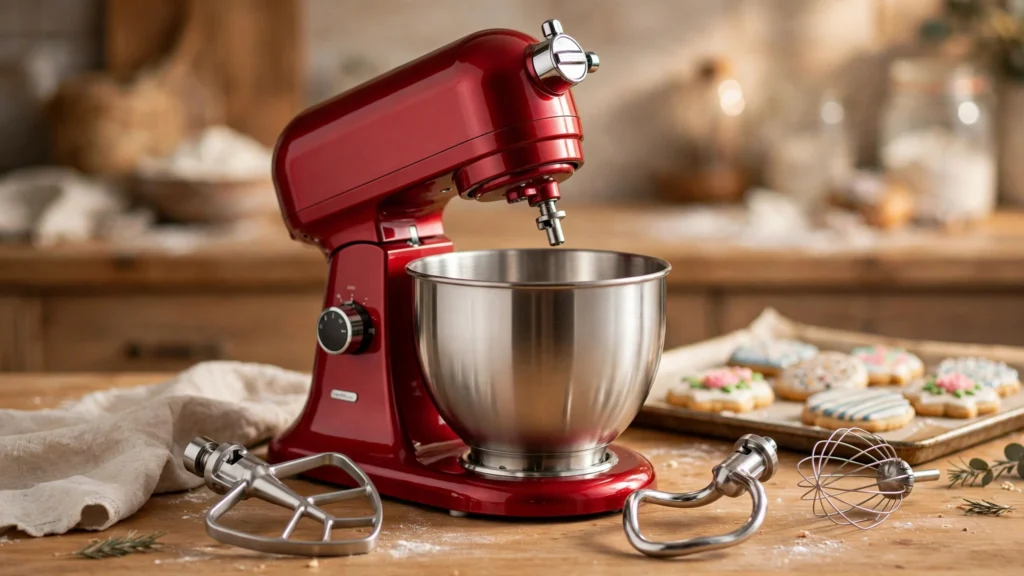
| Included | Flat beater, dough hook, 6-wire whip, pouring shield |
| Colors | 20+ |
What the Artisan Does Brilliantly
It handles 90% of home baking without breaking a sweat. Cookies, layer cakes, pound cakes, frostings, meringues, pizza dough, pancake batter — this is the Artisan’s home turf. The 59-point planetary mixing action means the beater touches far more of the bowl than older designs, so batters come together evenly with less scraping down the sides.
The attachment hub is a long-term value play. The powered hub on the front accepts KitchenAid’s lineup of attachments — pasta rollers, grain mills, meat grinders, vegetable sheet cutters, ice cream makers. A mixer that can become a pasta machine or a sausage stuffer earns its counter space many times over.
It’s built to last 10+ years. The Artisan’s all-metal transmission and sturdy build are why so many kitchens still run the same machine a decade later. Parts and service are widely available, which matters more than most people realize when buying an appliance meant to last.
It looks good on the counter. This sounds shallow until you own one. A stand mixer this heavy lives on the counter, not in a cabinet — and with 20+ colors, the Artisan is one of the few appliances people actually enjoy looking at every day.
Where It Falls Short
Heavy dough strains the motor. This is the Artisan’s real weakness. Dense, low-hydration bread doughs — bagels, stiff whole-wheat loaves — can make the 325-watt motor labor audibly. If you bake bread regularly, keep the mixer on speed 2 (never higher for dough), work in moderate batch sizes, and give the motor rest between batches. Serious bread bakers should look at a bowl-lift model instead.
The beaters are coated, not stainless steel. The included flat beater and dough hook are burnished/coated rather than solid stainless, so they’re not supposed to go in the dishwasher (the coating can chip over time with harsh detergents). Stainless replacements exist, but they cost extra.
It’s heavy — about 22 lbs. That weight is part of why it stays planted while kneading, but it also means you won’t be carrying it in and out of a cabinet. Plan on giving it a permanent home on the counter.
Full price is a premium. At its list price, the Artisan costs meaningfully more than competent competitors like the Cuisinart Precision Master. The value equation changes dramatically on sale, though — and the Artisan goes on sale often.
Who Should Buy It — and Who Should Skip It
Buy the Artisan if: you bake cookies, cakes, frostings, and batters regularly; you want a machine that can grow into pasta-making, grinding, and other projects via attachments; you value a proven 10+ year lifespan and widely available parts; or you want the color and design choice no competitor matches.
Skip it if: you mainly bake heavy bread dough (a bowl-lift model with more power will serve you better); you need something light you can stash in a cabinet; you’re on a tight budget and rarely bake (a good hand mixer may be enough — see our stand mixer vs hand mixer comparison); or you can’t wait for a sale and the full price stings.
Artisan vs the Alternatives
KitchenAid Classic: The entry-level tilt-head. Smaller bowl (4.5 qt) and fewer refinements, but the same basic DNA at a lower price. A sensible pick if the Artisan’s capacity and colors don’t matter to you and you want the cheapest way into the KitchenAid ecosystem.
KitchenAid Professional 600: The step up for serious bakers. A 6-quart bowl-lift design with a 575-watt motor and spiral dough hook that handles heavy dough far more comfortably than the Artisan. Bigger, louder, pricier — but the right tool if bread is your main event.
KitchenAid Artisan Mini: The compact sibling with a 3.5-quart bowl and a smaller footprint. Same 10 speeds and tilt-head convenience for small kitchens and small batches — but noticeably less capacity. Choose the Mini for tight counters and 1–2 person baking; choose the full-size Artisan for family-size batches.
For the full side-by-side, see our Best Stand Mixer 2026 roundup.
Black Friday Watch
The Artisan is one of the most reliably discounted stand mixers of the year. The deepest price drops land in the Black Friday and Cyber Monday window in late November, with solid secondary sales around holiday weekends and Prime Day–style events. If you’re not in a hurry, pick your color now and wait for the late-November wave — patience routinely saves buyers a significant chunk off list price. Set a price alert on the model (KSM150PS) so you’ll catch the dip when it happens.
Frequently Asked Questions
Is the KitchenAid Artisan worth it in 2026?
For most home bakers, yes. The Artisan still handles the vast majority of home baking brilliantly, the attachment hub extends its usefulness for years, and it’s built to last a decade or more. The key is buying on sale — at full price the value is harder to justify against cheaper rivals.
What’s the difference between the Artisan and Artisan Mini?
The full-size Artisan has a 5-quart bowl and handles family-size batches (up to 9 dozen cookies), while the Artisan Mini has a 3.5-quart bowl and a smaller, lighter footprint for tight kitchens. Both have 10 speeds and a tilt-head design. Choose the Mini for small batches and small counters; choose the Artisan for larger recipes.
Can the Artisan knead bread dough?
Yes, for moderate doughs. It handles standard yeast doughs, pizza dough, and enriched doughs like brioche well. The rule is simple: knead on speed 2 only, never higher, and keep batches moderate. Very stiff, low-hydration doughs (bagels, dense whole wheat) will strain the 325-watt motor — frequent bread bakers should consider a bowl-lift model like the Professional 600.
Are the attachments worth buying?
They can be — that’s the hub’s long-term value. The pasta roller set, grain mill, and food grinder are the standouts and perform genuinely well. Our advice: buy the mixer first, then add attachments one at a time as real projects come up, rather than buying a bundle upfront.
Which color Artisan should I get?
Pick the one you’ll enjoy seeing on your counter every day — with 20+ colors there’s no wrong answer. Practical notes: darker finishes (Onyx Black, Empire Red) show fewer scuffs and tend to hold resale value well; limited-edition colors cost more and can be harder to match if you add accessories later.
How long does a KitchenAid Artisan last?
A well-kept Artisan routinely lasts 10 years or more. Its all-metal transmission and widely available replacement parts are the reason so many decade-old machines are still running. Wipe down the body, hand-wash the coated beaters, and don’t push past speed 2 on heavy dough, and it should serve you for a very long time.
When is the best time to buy a KitchenAid Artisan?
Black Friday and Cyber Monday in late November bring the year’s deepest discounts, with additional sales around holidays and Prime Day–style events. The Artisan is discounted so often that paying full list price is rarely necessary — set a price alert on model KSM150PS and buy the dip.
Final Verdict
A decade into its reign, the KitchenAid Artisan remains the default recommendation for most home bakers in 2026 — not because it’s the most powerful or the cheapest, but because it’s the most complete package: a 5-quart workhorse for everyday baking, an attachment hub that keeps it useful for years, and a build quality that routinely stretches past a decade. Just don’t pay full price, and don’t ask it to be a heavy-duty bread machine.
If that sounds like your kind of mixer, wait for a sale and grab the color you love. It’s the rare appliance that earns its counter space.
Pair it with the right tools — see our KitchenAid mixer attachments guide.