
Affiliate disclosure: As an Amazon Associate we earn from qualifying purchases. If you buy through our links, we may earn a commission at no extra cost to you.
The Bottleneck Behind Every Christmas Bake
Here’s the thing nobody tells you about holiday baking: almost every beloved Christmas recipe — cutout sugar cookies, gingerbread, brioche, cinnamon rolls, frosted layer cakes — quietly assumes you own a stand mixer. Not a hand mixer straining at the edge of the bowl. A real stand mixer, running hands-free while you do something else.
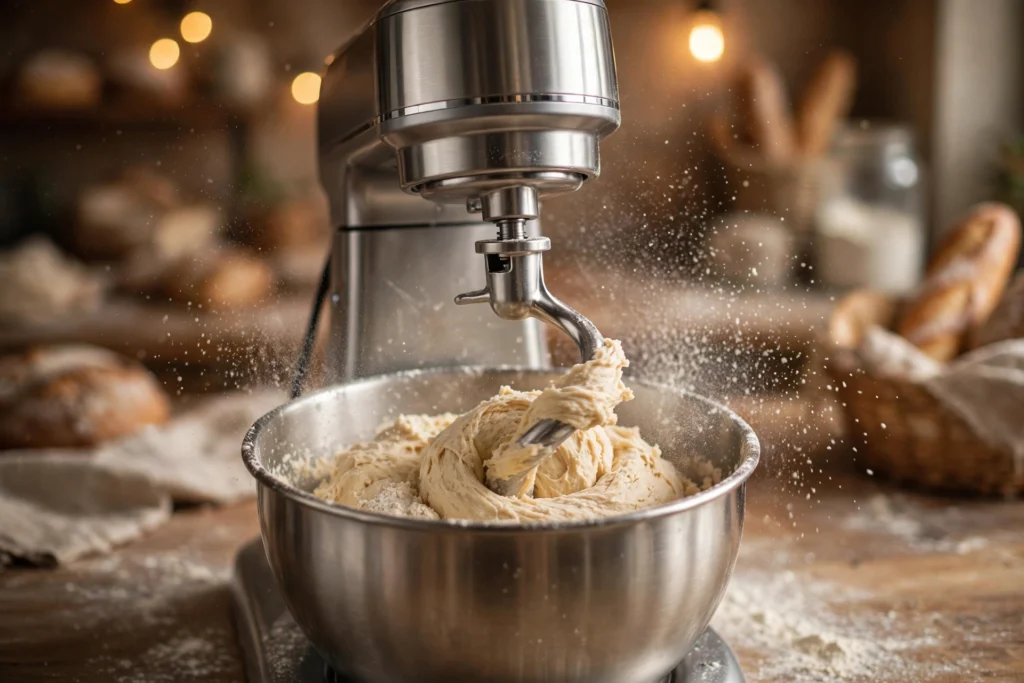
And it’s the single biggest upgrade a home baker can make. Creaming butter and sugar properly (the foundation of nearly every cookie) takes minutes of sustained beating that exhausts arms and underpowers hand mixers. Kneading bread dough by hand is a workout most people do exactly once. A good stand mixer doesn’t just save effort — it changes what you’re willing to bake.
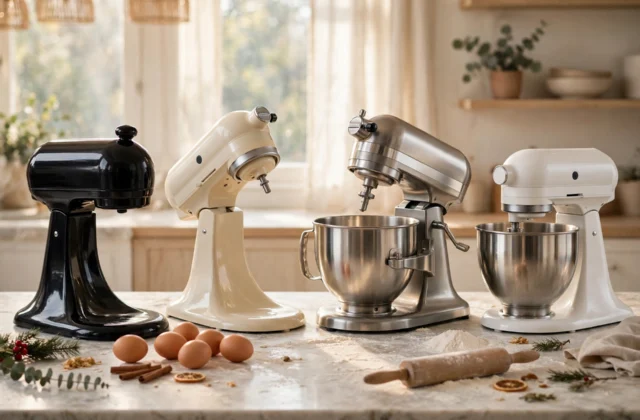
This guide compares the seven stand mixers actually worth buying in 2026, based on owner feedback, motor and build quality, bowl capacity, and real-world reliability — from the iconic KitchenAid Artisan to budget picks and bread-dough specialists. One note on timing: stand mixers see their deepest discounts of the year in late November. If you’re buying for Christmas, the smart move is to pick your model now and watch for the Black Friday wave — we’ll be tracking the deals.
Not sure you need a stand mixer at all? See our stand mixer vs hand mixer comparison.
Already pressing spritz cookies? Our best cookie press 2026 guide covers the shaping — a mixer is what gets your dough to that stage in the first place.
Quick Picks
Best Overall — KitchenAid Artisan Series 5-Quart (KSM150PS): The icon for a reason. Amazon’s Choice in stand mixers, a 5-quart bowl that handles 9 dozen cookies, and the attachment ecosystem no competitor touches. The default right answer for most bakers.
Best Value — Cuisinart Precision Master SM-50 (5.5-Qt): More watts, a bigger bowl, and a 3-year warranty — at a meaningfully lower tier than the Artisan. The rational pick if brand loyalty isn’t driving.
Best Premium — KitchenAid 7-Quart Bowl-Lift (KSM70SKXX): For the baker who batch-bakes for crowds: 7 quarts, 11 speeds, and double the bowl power of a tilt-head. The “buy the biggest once” option.
Best Stand Mixer Comparison
| Product | Best For | Design / Capacity | Key Spec |
|---|---|---|---|
| KitchenAid Artisan Series 5 (KSM150PS) | Best overall | Tilt-head, 5 qt | Amazon’s Choice; 325W; 10 speeds |
| KitchenAid Professional 600 (KP26M1X) | Bread & big batches | Bowl-lift, 6 qt | 575W; spiral dough hook; 3-point bowl lock |
| Cuisinart Precision Master SM-50 | Best value | Tilt-head, 5.5 qt | 500W; 12 speeds; 3-year warranty |
| Bosch Universal Plus (MUM6N10UC) | Serious bread dough | Bottom-drive, 6.5 qt | 500W belt drive; highest dough capacity |
| KitchenAid Artisan Mini (KSM3316X) | Small kitchens | Tilt-head, 3.5 qt | 250W; 14.3 lbs; full attachment hub |
| Hamilton Beach 63391 | Best budget | Tilt-head, 4 qt | 300W; 7 speeds; planetary mixing |
| KitchenAid 7-Qt Bowl-Lift (KSM70SKXX) | Premium / crowds | Bowl-lift, 7 qt | 11 speeds; double flex edge beater |
What to Look for in the Best Stand Mixer
Tilt-Head vs Bowl-Lift: Which Design Suits You?
This is the first fork in the road. Tilt-head mixers (the Artisan, Cuisinart, Hamilton Beach, Mini) hinge the whole motor head backward so you can lift the bowl straight out — easy ingredient access, easy beater swaps, smaller footprint. They’re the right choice for most home bakers doing cookies, cakes, and frosting.
Bowl-lift mixers (the Professional 600, the 7-Qt) keep the head fixed and crank the bowl up into position on a lever, locking it at three points. The payoff is stability: nothing wobbles when you’re kneading stiff dough, and the design handles bigger, heavier batches without complaint. The price is bulk — they’re taller, heavier, and swapping beaters takes an extra step. Rule of thumb: if bread dough is a weekly event or you regularly double recipes, go bowl-lift. Otherwise, tilt-head is the more pleasant daily driver.
Motor Power, Decoded: Why Watts Aren’t the Whole Story
Shoppers fixate on wattage, and manufacturers know it. Here’s the honest version: watts measure electricity draw, not mixing strength — what matters is how much of that power reaches the bowl as torque, which is why a well-geared 325W KitchenAid out-mixes plenty of cheap 500W machines. That said, wattage still tells you something about a mixer’s intent: machines under ~300W are built for batters and light doughs and will strain audibly on stiff bread dough, while 500W+ machines are engineered with dough in mind.
The practical read: for cookies, cakes, and frosting, anything from the established brands here is plenty. For regular bread baking, treat ~500W and a bowl-lift or belt-drive design as your floor — the Bosch and the Professional 600 exist precisely for that job.
Bowl Capacity vs. What You Actually Bake
Bowl size is the spec people overbuy most. A 5-quart bowl (the Artisan) handles 9 dozen cookies or several loaves’ worth of dough in one batch — more than most families need, and the sweet spot for holiday baking. Step down to 3.5 quarts (the Mini) and you’re fine for 1–2 person households but doubling recipes gets tight. Step up to 6–7 quarts and you’re in batch-baking-for-a-crowd territory: great for cookie exchanges and big families, but a half-batch of frosting in a 7-quart bowl won’t reach the beater properly.
Buy for the baking you do weekly, not the fantasy of the baking you might do once. An oversized bowl used for small batches mixes worse, not better.
The Attachment Ecosystem: KitchenAid’s Real Moat
Every mixer here has a hub or port for attachments — but they’re not equal. KitchenAid’s power hub fits 10+ attachments (pasta rollers, grain mills, meat grinders, ice cream makers, vegetable slicers), and crucially, a huge third-party market makes compatible attachments too. Owners consistently cite this as the reason they stay in the KitchenAid family: the mixer you buy for cookies becomes a pasta station, a sausage grinder, a grain mill.
Cuisinart offers a smaller but real attachment line (pasta, meat grinder, ice cream maker). Bosch has its own accessory system geared toward baking (slicer/shredder, grain mills).
Hamilton Beach’s ecosystem is the thinnest — fine if you’ll never attach anything, a limitation if you might. If “one machine, many jobs” appeals to you, weight the ecosystem heavily.
Looking for attachments? See our full KitchenAid mixer attachments guide.
Planetary Mixing: The Non-Negotiable
Every pick on this list uses planetary mixing — the beater spins on its own axis while orbiting the bowl, touching dozens of points per rotation. This is what separates a stand mixer from a hand mixer flailing in the middle of the bowl: full coverage, no unmixed pockets at the edges, no stopping to scrape (or not much). If you ever see a stand mixer without planetary action, that’s your sign to keep walking. All seven here clear the bar.
Noise, Weight, and What Actually Breaks
Two honest trade-offs. Weight is stability: a 25-pound mixer doesn’t walk across the counter kneading dough; a 13-pound one might need a hand on it. But weight is also permanence — heavy mixers live on the counter, light ones get lifted in and out of cabinets (the Hamilton Beach’s carry handle exists for exactly this reason). Noise scales with power: bowl-lift workhorses are louder than tilt-heads, and every stand mixer is louder than you expect the first time. None of this is a defect; it’s physics.
What breaks, per owner reports across brands: plastic gears in the cheapest machines (the reason budget picks stay budget), worn drive belts after years of heavy dough (Bosch belts are replaceable — a feature, not a flaw), and cosmetic chipping on coated beaters. Metal gears and all-metal construction are the durability signals worth paying for, and they’re exactly what separates the mid-tier from the premium tier here.
1. KitchenAid Artisan Series 5 (KSM150PS) — Best Overall
If you buy one stand mixer in 2026, make it this one. The Artisan Series 5 is the best-selling stand mixer on Amazon — holding Amazon’s Choice and the #1 spot in the stand mixer category — and it’s the rare product where the hype and the owner consensus agree: 10 speeds, a 5-quart bowl that genuinely handles 9 dozen cookies per batch, and the 59-point planetary mixing that leaves no dry pockets.
The tilt-head design is the everyday-friendly choice: flip the head back, swap beaters, scrape the bowl, done. The 325W motor is the spec skeptics cite, but owners report it powers through cookie dough, thick batters, and moderate bread dough without complaint — KitchenAid’s gearing, not raw wattage, does the work. And then there’s the ecosystem: the power hub fits 10+ attachments, which is why Artisan owners keep discovering new uses years after buying.
Specs: 5-qt stainless bowl · 325W · 10 speeds · tilt-head · 59-point planetary mixing · attachment hub (10+ attachments) · pouring shield included.
Pros: Category-leading owner consensus; the attachment ecosystem is unmatched; 20+ color options; proven across decades of kitchens; handles cookies, cakes, frosting, and moderate dough with ease.
Cons: 325W can strain on very stiff, large-batch bread dough (that’s what the bowl-lifts are for); premium-tier pricing; 1-year warranty is short for the price (Cuisinart gives three).
Who it’s for: The default recommendation — regular home bakers, Christmas cookie marathons, anyone who wants the safe, proven, do-everything pick.
Read our full KitchenAid Artisan stand mixer review.
2. KitchenAid Professional 600 (KP26M1X) — Best for Bread & Big Batches
When the Artisan isn’t enough mixer, this is the step up. The Professional 600 pairs a 575W motor with a 6-quart bowl-lift design — the head stays put, the lever cranks the bowl up into three locking points, and nothing wobbles when you’re kneading dense dough. Owners describe it as the closest thing to a commercial mixer that fits under a home cabinet.
The practical differences from the Artisan: more power where it counts (dough, not frosting), a spiral PowerKnead dough hook instead of a C-hook, and meaningful extra capacity — 13 dozen cookies per batch. The trade-offs are real too: it’s taller, heavier, and louder, and swapping attachments takes more doing than a tilt-head. This is a specialist’s machine that happens to also do everything else.
Specs: 6-qt stainless bowl · 575W · 10 speeds · bowl-lift with 3-point lock · spiral PowerKnead dough hook · 67-point planetary mixing.
Pros: Serious dough power without strain; rock-solid stability on heavy batches; big capacity for batch baking; same attachment hub as the Artisan.
Cons: Bulkier and louder than tilt-heads; overkill if bread is occasional; bowl-lift beater swaps are fussier; premium tier.
Who it’s for: Weekly bread bakers, big-batch holiday bakers, and anyone whose mixer will regularly face stiff, heavy dough.
Read our full KitchenAid Professional 600 stand mixer review.
3. Cuisinart Precision Master SM-50 — Best Value
The rationalist’s pick. The Cuisinart SM-50 gives you a 500W motor, a 5.5-quart bowl, and 12 speeds — on paper, more of everything than the Artisan — at a meaningfully lower tier, backed by a 3-year warranty (triple KitchenAid’s). Owners consistently report it matches the Artisan on the jobs most people actually do: cookies, cakes, frosting, whipped cream.
So what’s the catch? Two things, both honest. First, the attachment ecosystem is smaller — pasta, meat grinder, and ice cream maker exist, but nothing like KitchenAid’s universe. Second, the feel: die-cast metal body, but owners note it doesn’t have quite the bank-vault solidity of the KitchenAid. Neither matters if you just want an excellent mixer for baking. It also runs a touch louder at high speed, per owner reports.
Specs: 5.5-qt stainless bowl · 500W · 12 speeds · tilt-head · die-cast metal body · 3-year limited warranty · splash guard with pour spout.
Pros: More watts and capacity than the Artisan for less money; 3-year warranty is the best here; strong owner satisfaction on core baking tasks; good color range.
Cons: Smaller attachment ecosystem; slightly less premium feel; a bit louder at top speed; resale and community support trail KitchenAid.
Who it’s for: Value-driven buyers who want maximum mixer for the money and don’t care about the attachment universe.
4. Bosch Universal Plus (MUM6N10UC) — Best for Serious Bread Dough
The odd one out — and the bread baker’s secret weapon. The Bosch Universal Plus doesn’t look like the others because it isn’t: a bottom-drive design with a 500W belt-driven motor, a huge 6.5-quart bowl, and a completely different mixing action. Instead of a beater orbiting the bowl, the bowl’s center column drives the action while dough gets worked against the sides. Bread bakers swear by it.
The numbers tell the story: the highest dough capacity in this roundup — owners routinely mix dough for a dozen-plus loaves in one go — in a machine that weighs far less than the KitchenAids because the motor doesn’t need to be a counterweight. The belt drive is a feature, not a compromise: it’s replaceable if it ever wears, and it keeps the machine quieter than you’d expect. The honest caveats: it’s less elegant for small-batch cakes and frosting (the design favors volume), the aesthetic is utilitarian, and the attachment world is baking-focused rather than everything-focused.
One transparency note: the live Amazon US listing is a bundle with a dough hook extender (that’s how Bosch sells it there) — the mixer itself is the same MUM6N10UC.
Specs: 6.5-qt bowl · 500W belt-drive motor · bottom-drive design · highest dough capacity in class · replaceable belt · Amazon’s Choice.
Pros: Unmatched bread-dough capacity; lightweight for its capability; quiet for its power; belt drive is serviceable; beloved by serious bread bakers.
Cons: Overkill (and awkward) for small cake/frosting batches; utilitarian looks; smaller general attachment ecosystem; the bundle listing confuses some buyers.
Who it’s for: Bread-first bakers — sourdough regulars, big-batch dough makers, anyone whose mixer earns its keep in loaves, not layers.
Read our full Bosch Universal Plus review.
5. KitchenAid Artisan Mini (KSM3316X) — Best Compact
All of the Artisan’s DNA, sized for real kitchens. The Mini keeps the tilt-head design, the 10 speeds, the attachment hub, and the 20+ color options — in a 3.5-quart, 14-pound package that fits under cabinets and lifts with one hand. For apartments, small kitchens, and anyone who resents countertop sprawl, it’s the KitchenAid that actually fits.
The 250W motor and smaller bowl are honest limitations, not flaws: 5 dozen cookies per batch is plenty for 1–2 person households, and owners report it handles everyday doughs fine. But this isn’t the mixer for double batches or weekly bread — the bowl runs out before the motor does. You’re trading capacity for footprint, and for the right kitchen that’s exactly the right trade.
Specs: 3.5-qt stainless bowl · 250W · 10 speeds · tilt-head · 14.3 lbs · full attachment hub · Amazon’s Choice.
Pros: Genuine KitchenAid quality in a small footprint; uses the same attachments as full-size models; light enough to store in a cabinet; 20+ colors.
Cons: 3.5-qt bowl limits batch size; 250W isn’t for stiff bread dough; the per-quart value trails the full Artisan.
Who it’s for: Small kitchens, 1–2 person households, and anyone who wants the KitchenAid ecosystem without the countertop commitment.
6. Hamilton Beach 63391 — Best Budget
The honest budget option. The Hamilton Beach 63391 is a 7-speed, 4-quart tilt-head with genuine planetary mixing — the same rotating action as mixers costing several times more — and it holds the #4 best-seller spot in the stand mixer category on Amazon. Thousands of owners use it happily for cakes, cookies, and whipped cream.
The caveats are the price of the price. The 300W motor handles batters and soft doughs but bogs down audibly on stiff bread dough — owners are clear this isn’t a bread machine. The body is largely plastic, so it feels it, and at roughly 8–13 pounds (depending on how you count) it’s light enough to need a steadying hand on heavy jobs. But the tilt-head, the printed mixing guide on the housing, the dishwasher-safe everything, and the carry handle make it a genuinely pleasant machine for what it’s built to do.
Specs: 4-qt stainless bowl · 300W · 7 speeds · tilt-head · planetary mixing · dishwasher-safe bowl and attachments · 1-year warranty.
Pros: Real planetary mixing at the lowest tier here; category best-seller with a huge owner base; light with a carry handle; everything dishwasher-safe; ideal gift price.
Cons: 300W struggles with stiff bread dough; plastic body feels budget; light enough to walk on heavy jobs; thinnest attachment story here.
Who it’s for: Budget buyers, first apartments, and bakers whose heaviest job is cookie dough — everyone else should step up.
7. KitchenAid 7-Quart Bowl-Lift (KSM70SKXX) — Best Premium
For the baker who batch-bakes for a crowd and wants to buy the biggest once. The 7-quart bowl-lift is KitchenAid’s current flagship for home use: 11 speeds (including a half-speed for folding), a double flex edge beater that scrapes as it mixes, and — in KitchenAid’s words — twice the power in the bowl of a tilt-head. Thirteen dozen cookies per batch, over 8 pounds of bread dough, mashed potatoes for a holiday table.
This is unapologetically a lot of mixer: 29 pounds, 16.5 inches tall (measure your cabinets), and the premium tier of this roundup. Owners who need it love it — cookie-exchange hosts, big-family bakers, small cottage-food operations. Everyone else should save the money and the counter space. If the Professional 600 is the sensible workhorse upgrade, this is the “never think about capacity again” purchase.
Specs: 7-qt stainless bowl · 11 speeds incl. half-speed · bowl-lift · double flex edge beater · 11-wire whip · #10 in stand mixers on Amazon.
Pros: Maximum home capacity; genuinely more bowl power than tilt-heads; the flex edge beater reduces scraping; same attachment hub; built for serious volume.
Cons: Very large and heavy — measure first; premium pricing; overkill for normal family baking; louder than smaller models.
Who it’s for: Batch bakers, big families, holiday hosts, and anyone who’d rather buy capacity once than wish for it every December.
Black Friday Watch: Why Timing Matters for This Purchase
Stand mixers are the single most discount-sensitive category we cover. Every year, late November brings the deepest cuts in kitchen electrics — and stand mixers lead the pack, with the major brands routinely taking significant markdowns off their most popular models. We’ve tracked these cycles: the October sale events almost always preview the Black Friday pricing, which means the discounts you see in early November are the signal, not the noise.
Our advice: pick your model from this guide now, so you’re deciding with a clear head — then watch the deals. We’ll be publishing dedicated Black Friday deal posts for the top picks as the sales go live, with the live prices and the models actually worth buying at each discount tier. If you’re buying for Christmas, late November is historically the moment.
Frequently Asked Questions
Should I get a tilt-head or a bowl-lift stand mixer?
Tilt-head for most home bakers: easier ingredient access, simpler beater swaps, smaller footprint — better for cookies, cakes, and frosting. Bowl-lift for heavy, frequent dough work and big batches: the fixed head and locking bowl stay rock-solid under load, at the cost of size and a fussier beater change. If bread dough is a weekly event, go bowl-lift; otherwise, tilt-head is the more pleasant daily driver.
Is a KitchenAid worth the premium over Cuisinart?
It depends what you’re buying. For pure mixing performance on cookies, cakes, and frosting, owners report the Cuisinart SM-50 matches the Artisan at a lower tier — the rational value pick. What the KitchenAid premium buys is the attachment ecosystem (10+ attachments plus a huge third-party market), deeper color options, stronger resale value, and a community of owners a decade deep. If you’ll ever want the pasta attachment, the premium pays for itself; if not, it doesn’t.
How much power do I need for bread dough?
For occasional loaves, the tilt-heads here manage — owners report the Artisan handles moderate bread dough, though it works audibly harder. For regular bread baking, treat ~500W plus a bowl-lift or belt-drive design as your floor: the KitchenAid Professional 600 and Bosch Universal Plus are built for exactly that. Under ~300W, stick to batters and soft doughs — stiff bread dough will bog the motor down.
Can a stand mixer replace a hand mixer?
Mostly, yes — and then some. A stand mixer does everything a hand mixer does, hands-free, plus doughs a hand mixer can’t touch. The hand mixer keeps two advantages: small, quick jobs (whipping a cup of cream) and portability. Many owners keep both: the stand mixer for baking sessions, a cheap hand mixer for the 30-second jobs. If you bake weekly, the stand mixer earns its counter space.
What stand mixer attachments actually matter?
The three that get used: a pasta roller (fresh pasta is the gateway attachment), a food grinder (burgers and sausage), and a grain mill (for the bread-obsessed). The ice cream maker is fun but seasonal; the spiralizer and slicer/shredder are nice-to-haves. Honest advice: buy the mixer for the mixer, not the attachments — then add one attachment a year as the habit forms. The KitchenAid hub fits 10+, which is why its ecosystem is the moat.
Is the Artisan Mini enough for a family?
For a 1–2 person household that bakes regularly, yes — 5 dozen cookies per batch covers most weeks. For a family of four-plus, or anyone who batch-bakes for holidays and cookie exchanges, the 3.5-quart bowl becomes the constraint: you’ll be running double batches while a 5-quart owner runs one. The Mini is a space decision, not a value decision — if the full Artisan fits, it’s the better buy per quart.
Will it handle double batches?
The 5-quart and larger bowls here are designed for it — the Artisan’s 9-dozen-cookie rating and the Professional 600’s 13-dozen rating are exactly this scenario. Two rules from owner experience: don’t exceed the bowl’s rated capacity (dough climbs the hook and strains the motor), and for very stiff double-batch bread dough, step up to a bowl-lift or the Bosch. When in doubt, mix big batches on a lower speed for longer rather than forcing high speed.
Final Recommendation
For most buyers this Christmas, the KitchenAid Artisan Series 5 remains the best stand mixer to buy: the category’s most proven machine, the attachment ecosystem no one else touches, and thousands of kitchens of owner consensus behind it. If value is the driver, the Cuisinart Precision Master SM-50 gives you more watts and a bigger bowl for less money — the rational pick. Bread-first? The Bosch Universal Plus is the specialist’s choice, and the Professional 600 is the KitchenAid family’s answer. Small kitchen? The Artisan Mini. Tight budget? The Hamilton Beach 63391 gets real planetary mixing on the counter for the lowest tier here. And if you’re feeding a crowd, the 7-Quart Bowl-Lift ends the capacity conversation for good.
Buying for a baker who has everything? A stand mixer is the milestone gift — and our pizzelle maker gift ideas cover the smaller end of the Christmas list. Pair the mixer with a fresh batch of dough, and when the cookies are baked, our best cookie decorating kit guide picks up where the mixer leaves off. And remember: pick the model now, buy on the Black Friday wave.
Affiliate disclosure: As an Amazon Associate we earn from qualifying purchases.